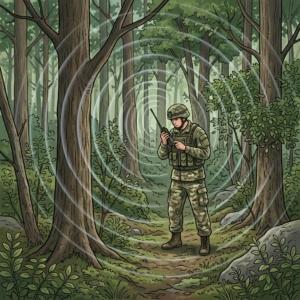
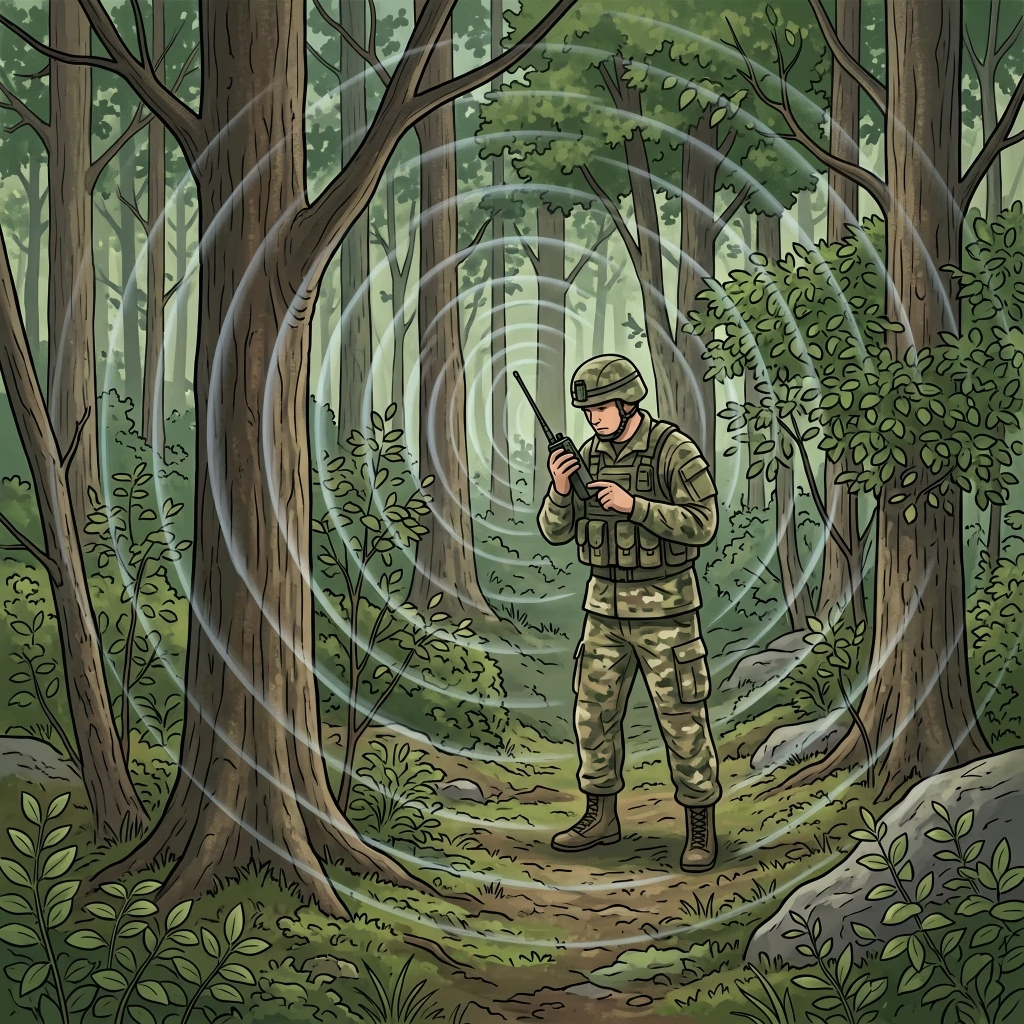
Of four everyday radios a soldier might carry, a smartwatch on Bluetooth is by far the hardest to detect, and a handheld UHF radio is by far the easiest. With the soldier 100 m inside a forest and the listener on a 10 m mast, the watch is detectable at under 100 m. The handheld radio is detectable at more than 10 km.
This article asks a simple question: how far away can an enemy detect, and then locate, a device that a soldier carries? We compare four transmitters, using commercial products and open frequency bands as examples:
- A smartwatch with Bluetooth Low Energy (2.4 GHz), for example a Garmin tactix.
- A smartphone worn on the chest rig, with its mobile network, Wi-Fi and Bluetooth radios active.
- A LoRa mesh node, for example a RAKwireless WisBlock running MeshCore on the 869 MHz licence-free band, with its standard antenna.
- A handheld UHF radio on the 70 cm amateur band (433 MHz), sending data packets controlled from a smartphone over Bluetooth.
The point is not the specific products. It is to show how power, frequency, terrain and the listener’s position together decide how far a signal reaches, so that the same reasoning can be applied to any device.
Background
Every radio transmission can be heard by more than the intended receiver. Military forces have long practised emission control (EMCON): transmitting only when necessary, with as little power as possible, and for as short a time as possible. This is a very sound basic idea when using equipment sending out electromagnetic waves in a military context.
Recent conflicts have made the threat concrete. Cheap software-defined radios (SDRs), commercial drones and well-known signal-processing tools now let a small unit detect, take bearings on and identify emitters. A detected emitter can be targeted by artillery or drones within minutes.
This has led to a reasonable fear of any electronics that transmit. A common example is the rule against wearing a smartwatch with Bluetooth enabled in the field. The question is how large that risk actually is compared with the other radios soldiers carry, and the answer depends on physics that can be calculated.
We use commercial devices and open bands because their parameters are public and easy to check. Military radios use other frequencies, waveforms and power levels, but the same laws of physics apply to them.
Mathematics
Whether an emitter can be detected comes down to one subtraction: the signal power that reaches the listener, minus the weakest signal the listener’s receiver can pick out. If the result is positive, the emitter is detectable.
Decibels
Radio engineers count power in decibels (dB) because the numbers involved span an enormous range. A handheld radio transmits about 5 W, while the signal reaching a receiver a few kilometres away can be less than a millionth of a millionth of a milliwatt. In watts, such numbers are long strings of zeros. In decibels, they become numbers between roughly −150 and +40 that can simply be added and subtracted. Power relative to one milliwatt is written dBm.
| Change | Meaning |
|---|---|
| +3 dB | twice the power |
| +10 dB | 10 times the power |
| +20 dB | 100 times the power |
| +30 dB | 1,000 times the power |
| 0 dBm | 1 mW |
| +30 dBm | 1 W |
| −100 dBm | 0.1 picowatt (10⁻¹³ W) |
As a rule of thumb, 20 dB more in a link budget gives about ten times the range in free space, and about three times the range close to the ground.
A ratio on a logarithmic scale
A decibel is not a unit of power in itself. It describes the ratio between two powers, P₁ and P₂, on a logarithmic scale:
\text{dB} = 10 \log_{10}\left(\frac{P_2}{P_1}\right)
The base-10 logarithm answers the question: how many times must 10 be multiplied by itself to give this number? So log₁₀(10) = 1, log₁₀(100) = 2 and log₁₀(1,000) = 3. Each factor of ten in power therefore adds 10 dB.
Two worked examples:
- An amplifier that raises 2 W to 20 W gives 10 × log₁₀(20 / 2) = 10 × log₁₀(10) = 10 dB.
- Doubling the power, from 1 W to 2 W, gives 10 × log₁₀(2) = 10 × 0.301 = 3 dB. Halving it gives −3 dB.
Why decibels make the arithmetic easy
Logarithms turn multiplication into addition. In watts, a transmitter’s power is multiplied by the antenna’s gain, then multiplied by a tiny fraction for every loss on the way. In decibels the same calculation is a plain sum. A 5 W radio (+37 dBm) with a −3 dB antenna, 3 dB body loss and 128 dB path loss delivers:
37 - 3 - 3 - 128 = -97 ; \text{dBm}
This is why the link budget below is written as a sum.
Absolute levels: dBm and dBi
To state an actual power rather than a ratio, the decibel is measured against a fixed reference. In radio the usual reference is one milliwatt, and the result is written dBm:
P_{dBm} = 10\log_{10}\left(\frac{P}{1,\text{mW}}\right) \qquad P_{mW} = 10^{,P_{dBm}/10}
For example, 5 W is 5,000 mW, and 10 × log₁₀(5,000) = 10 × 3.70 = 37 dBm. Going the other way, −110 dBm is 10⁻¹¹ mW, or 10⁻¹⁴ W.
Antenna gain is written dBi: gain compared with an ideal antenna that radiates equally in all directions (an isotropic antenna). A Yagi with 12 dBi concentrates 16 times as much power in its main direction. A small antenna with −3 dBi radiates only half as much as the ideal one.
The link budget
The received power is the radiated power minus all losses along the way, plus the gain of the listener’s antenna:
P_{rx} = \mathrm{EIRP} - L_{path} - L_{forest} + G_{rx}
EIRP is the effective radiated power: transmitter output, plus antenna gain, minus losses in the antenna and in the body of the person wearing it. All terms are in dB or dBm.
Path loss in free space
In open space, with clear line of sight, the loss grows with both distance and frequency:
L_{fs} = 20\log_{10}(d_{km}) + 20\log_{10}(f_{MHz}) + 32.44
At 5 km this gives 99 dB at 433 MHz, 105 dB at 869 MHz and 114 dB at 2,440 MHz. Higher frequencies lose more, partly because a small receiving antenna captures less energy at short wavelengths.
Path loss close to the ground
A device worn on the body sits about 1.2 m above ground. Beyond a certain breakpoint distance, the wave reflected off the ground cancels much of the direct wave, and loss grows four times faster with distance (the plane-earth model):
L_{pe} = 40\log_{10}(d_{m}) - 20\log_{10}(h_t h_r)
d_{break} = \frac{4\pi h_t h_r}{\lambda}
Here ht and hr are the antenna heights of the transmitter and receiver in metres, and λ is the wavelength. In practice, the larger of the free-space and plane-earth losses is used. The formula shows why height matters so much: every doubling of the listener’s antenna height cuts the loss by 6 dB.
| Listener’s antenna height | Loss over 5 km, transmitter at 1.2 m |
|---|---|
| 2 m (a person on the ground) | 140 dB |
| 10 m (mast or vehicle) | 126–128 dB |
| 30 m (hilltop or tower) | 117–118 dB |
| 100 m or more (high ground, drone) | close to free space |
Loss through forest
Needles, leaves, branches and trunks contain water, which absorbs radio energy. A widely used empirical model for propagation through trees is Weissberger’s model, valid for 14–400 m of vegetation:
L_{forest} = 1.33 , f_{GHz}^{0.284} , d_{m}^{0.588}
| Forest depth | 433 MHz | 869 MHz | 2,440 MHz |
|---|---|---|---|
| 100 m | 16 dB | 18 dB | 26 dB |
| 200 m | 24 dB | 28 dB | 39 dB |
| 400 m | 36 dB | 42 dB | 58 dB |
Lower frequencies pass through forest better. This matters a lot for the comparison below.
What the listener can hear
No receiver can hear below its own thermal noise. The noise floor depends on the bandwidth of the signal:
N = -174 + 10\log_{10}(B_{Hz}) + NF
NF is the receiver’s noise figure, typically 2–6 dB for a good SDR with a low-noise amplifier. A Bluetooth signal (1 MHz wide) has a noise floor of about −114 dBm, and a narrowband FM channel (12.5 kHz) about −133 dBm. Most signals must rise some decibels above the noise to be detected. LoRa is the exception: its chirp modulation can be decoded about 10 dB below the noise.
The radio horizon
The Earth curves away, so even in perfectly open terrain line of sight ends at the radio horizon:
d_{horizon} \approx 4.12\left(\sqrt{h_t} + \sqrt{h_r}\right) ; \text{km}
With the soldier at 1.2 m and the listener on a 10 m mast, the horizon is about 17.5 km. A drone at 300 m sees more than 70 km.
A worked example at 5 km
A smartwatch radiates about −6 dBm. Over 5 km of open ground to a listener on a 10 m mast, the path loss at 2.4 GHz is 128 dB:
P_{rx} = -6 - 128 = -134 ; \text{dBm}
A good receiver needs about −110 dBm, so the listener is 24 dB short. They would need a directional antenna with more than 24 dBi gain, which is a dish of about 1.5–2 m pointed in the right direction. If the soldier is 100 m inside a forest, another 26 dB is lost and detection becomes impossible.
Physics and facts
The four devices differ by almost 40 dB in radiated power, which is a factor of about 10,000. They differ just as much in how weak a signal the listener can still pick out.
The smartwatch (Bluetooth Low Energy, 2.4 GHz)
A Bluetooth chip in a watch typically transmits 0 to +4 dBm (1–2.5 mW). The small antenna inside a metal case is inefficient, and the wrist and body absorb a further 5–20 dB depending on how the arm is held. A realistic radiated power is about −6 dBm (0.25 mW).
The watch transmits in very short bursts, a fraction of a millisecond each, a few times per second while it searches for or stays connected to a phone. The bursts can carry a device name and a fixed address, which may identify the type of device. Some tactical watches, such as the Garmin tactix series, have a stealth mode that turns off all wireless transmission. GPS reception alone transmits nothing.
The smartphone on the chest rig
A smartphone carries three transmitters at once. The strongest is the mobile network radio. In rural areas it mainly uses the low bands (700–900 MHz), at up to +23 dBm (200 mW). Worn on the front of a chest rig, the body only shields the signal towards the rear. Forward and to the sides, the radiated power is about +16 dBm (40 mW).
Two things make it worse in the field. A phone far from a base station raises its power towards the maximum, so it is loudest exactly where soldiers operate. And the phone transmits more often than people expect: apps sync, notifications arrive, and the phone reports its location to the network. Wi-Fi (about +12 dBm when it searches for networks) and Bluetooth (about +3 dBm) add shorter-range signatures. The mobile network itself always knows which phone is connected.
The LoRa mesh node (RAKwireless with MeshCore, 869 MHz)
A RAKwireless WisBlock unit uses a Semtech SX1262 radio chip with up to +22 dBm (160 mW) output. With the standard stub antenna and some body loss, the radiated power is about +18 dBm (60 mW), similar to the phone.
The difference is on the receiving side. A commonly used European MeshCore preset sends on 869.6 MHz with 62.5 kHz bandwidth and spreading factor 8. LoRa’s chirp signal can be received at about −130 dBm, roughly 10 dB below the noise floor. Each packet lasts about a quarter of a second. The settings are public, so an enemy only needs the same inexpensive device to listen. MeshCore encrypts the message content, but node advertisements carry the node’s name and public key, and may carry its GPS position.
The handheld UHF radio (70 cm band, 433 MHz)
A typical amateur handheld transmits 5 W (+37 dBm) on high power and about 1 W (+30 dBm) on low. A short flexible antenna has a gain of about −3 dBi at this frequency. With body loss, the radiated power is about +31 dBm (1.3 W) on 5 W and +24 dBm on 1 W.
In this example the radio sends 1,200 bit/s AX.25 data packets (AFSK on FM), controlled from a smartphone over Bluetooth. A single message of a few hundred bytes takes about 1.5–2 seconds on air, including the preamble when the transmitter keys up, and lost frames must be resent. Every AX.25 frame carries the sender’s callsign in clear text, and amateur radio rules do not allow encryption that hides a message’s meaning. The Bluetooth link between phone and radio adds a weak extra signature of about +3 dBm.
The four devices side by side
| Smartwatch | Smartphone | LoRa node | Handheld UHF | |
|---|---|---|---|---|
| Frequency | 2,440 MHz | 700–900 MHz | 869 MHz | 433 MHz |
| Radiated power (EIRP) | −6 dBm | +16 dBm | +18 dBm | +31 dBm (5 W) |
| Weakest detectable signal | −110 dBm | −105 dBm | −130 dBm | −125 dBm |
| Link budget against a listener | 104 dB | 121 dB | 148 dB | 156 dB |
| Duration of one transmission | < 1 ms | short bursts | about 0.25 s | 1.5–2 s |
| Forest loss, 100 m | 26 dB | 19 dB | 18 dB | 16 dB |
| Who decides when it transmits | the watch | the phone and its apps | mostly the user | the user |
| Identifying content | device name, address | network identity | node name, key, maybe position | callsign in clear |
The link budget row is the key figure. It is the radiated power minus the weakest detectable signal, before any antenna gain at the listener. Each 20 dB more means roughly ten times the range in open terrain.
Detection at 5 km
The table shows the margin, in dB, that a listener with a simple omnidirectional antenna has at 5 km. A positive number means detection is possible without a directional antenna. A negative number is the antenna gain the listener would need.
| Scenario at 5 km | Smartwatch | Smartphone | LoRa node | Handheld UHF, 5 W |
|---|---|---|---|---|
| A. Line of sight, listener on high ground | −10 dB | +15 dB | +42 dB | +50 dB |
| B. Open ground, listener at 30 m | −13 dB | +4 dB | +31 dB | +39 dB |
| C. Open ground, listener on 10 m mast | −22 dB | −5 dB | +22 dB | +30 dB |
| D. Soldier 100 m in forest, 10 m mast | −48 dB | −24 dB | +3 dB | +14 dB |
| E. Soldier 200 m in forest, listener on the ground | −75 dB | −48 dB | −21 dB | −8 dB |
A good directional antenna gives 10–15 dBi (a Yagi) and a large dish 25–30 dBi, but it must be pointed in roughly the right direction. In practice, a gap of more than about 30 dB cannot be closed. The watch is beyond reach in every forest scenario, while the handheld radio is detectable with a simple antenna in all but the last.
Detection range in forest
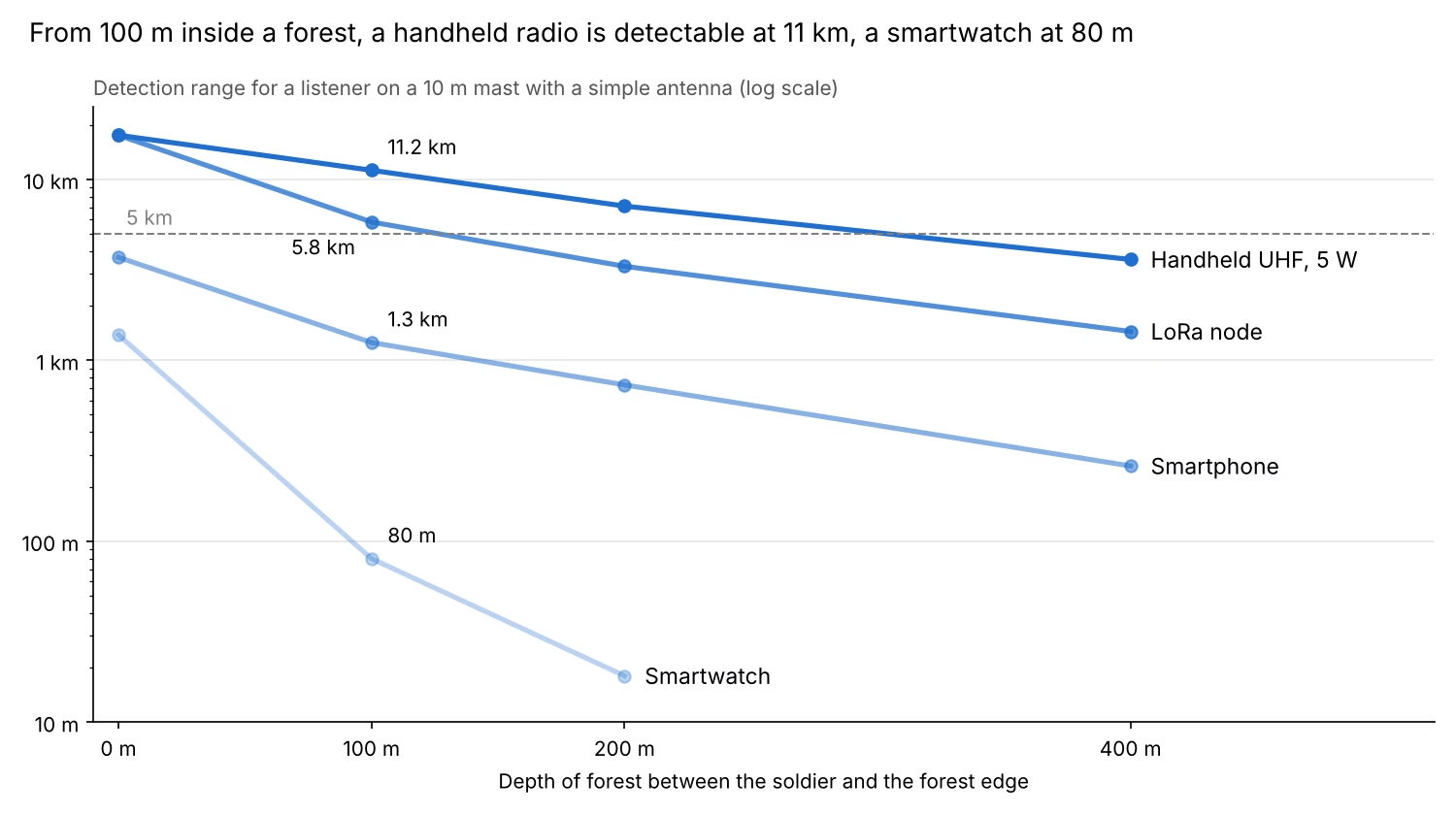
Model estimates for this article: plane-earth path loss, Weissberger forest model, listener at 10 m with a 0 dBi antenna, soldier at 1.2 m.
In open ground, the LoRa node and the handheld radio both reach the radio horizon at about 17.5 km. Behind more than about 200 m of forest, the smartwatch cannot be detected at all.
Reasoning
The fear of the smartwatch is justified in principle but overstated in distance. The devices that often go unquestioned, the phone and the field radio, are the ones that reach kilometres.
Detection, location and identification are three different things
Detecting that something transmits is the easiest step. Locating it is harder: a directional antenna typically gives a bearing accurate to 3–5 degrees, which at 5 km means an uncertainty of 260–440 m to either side. Two listening posts that cross their bearings narrow this to an area of a few hundred metres. A long transmission makes this much easier, because the operator has time to turn the antenna and find the peak. A 2-second packet from a handheld radio is far easier to take a bearing on than a Bluetooth burst lasting less than a millisecond.
Identification can matter as much as location. A Bluetooth device name, a callsign in clear text or a mesh node’s fixed name lets a listener recognise the same unit again later, and follow it over days.
The listener’s height decides more than the transmitter’s power
The tables show that raising the listener from 2 m to 30 m gains more than 20 dB, which is more than the difference between the phone and the LoRa node. High ground, masts and above all drones are what turn a short-range signal into a long-range one. A drone above a forest looks down through the canopy, which costs only about 10 dB, instead of through hundreds of metres of trunks.
This gives the most realistic threat picture. A distant listening post picks up that something transmits in a certain direction, and a drone is sent to search the area at close range.
Communication range equals detection range
For radios built for long range, such as LoRa and UHF handhelds, there is a simple rule. If a friendly unit at a certain place can receive the message, an enemy at the same place can detect it with the same kind of equipment. The enemy can also choose a higher position and a better antenna, so detection range is usually longer than communication range. Encryption does not change this: it hides what is said, not that something was sent.
A mesh network adds another effect. Every node that relays a message becomes a transmitter in its own right, and a relay on high ground is visible over a large area.
Consistency in the rules
If a unit forbids smartwatches with Bluetooth, it should take phones and radios at least as seriously. The phone on the chest rig radiates more than 100 times as much as the watch, on a frequency that passes through forest better, and it decides by itself when to transmit. A rule that bans the watch but allows the phone protects against the smallest risk and ignores the largest.
What reduces the risk
- Turn off what is not needed. Stealth mode on the watch. Flight mode on the phone, with Wi-Fi and Bluetooth checked off as well, since some phones turn them back on automatically.
- Use the lowest power that works. Every 6 dB less power roughly halves the open-ground detection range.
- Put terrain between yourself and the enemy. A hill or a ridge blocks the signal far better than any forest.
- Transmit rarely and briefly. Combine messages, avoid automatic beacons and position reports, and use error correction so fewer packets need resending.
- Move after transmitting. A bearing taken on one transmission points to where you were, not where you are.
- Avoid identifying content. Neutral node names, no position in mesh advertisements, and keys that are changed regularly.
How certain are these numbers?
The calculations use standard engineering models. Real terrain, weather, foliage density and the exact position of a device on the body can easily shift results by ±10 dB, which changes ranges by a factor of two to three. The ranking between the devices is much more robust than the individual figures, because the differences between them are larger than the uncertainty. Field measurements with an SDR are the best way to check the figures for a specific device and terrain.
Summary
Ranked from hardest to easiest to detect, the four devices are the smartwatch, the smartphone, the LoRa node and the handheld UHF radio.
| Device | Detectable at 5 km, soldier in forest? | Detection range, 100 m into forest, 10 m mast |
|---|---|---|
| Smartwatch, Bluetooth | No | about 80 m |
| Smartphone on chest rig | Only with a large directional antenna | about 1.3 km |
| LoRa node, MeshCore | Yes, barely, with a simple antenna | about 6 km |
| Handheld UHF radio, 5 W | Yes, easily | about 11 km |
- A smartwatch on Bluetooth is detectable at tens to a few hundred metres, not kilometres. Detection at 5 km requires line of sight, a listener on high ground and a large dish.
- A smartphone is 100–1,000 times more of a risk than the watch, mainly because of its mobile network radio.
- Radios built for long range are, for the same reason, detectable at long range. For LoRa and UHF handhelds, the detection range is at least as long as the communication range.
- The listener’s height and drones matter more than any single device setting.
- The best protection is the same for all four: transmit nothing that is not needed, use the lowest power that works, keep transmissions short and rare, and use terrain as a shield.
All figures are model estimates with an uncertainty of about ±10 dB. They show the order of magnitude and the ranking, not exact distances.
Let us know your thoughts on radio transmitters in military context!