Notes from a spring 2026 comparison trial
This spring, Nerio Defense had the opportunity to take part in a field test run by a military unit that wanted to compare situational-awareness and communication tools head to head, under realistic conditions rather than in a meeting room. Three tools were put side by side: Signal, the TAK platform (ATAK on Android and iTAK on iOS) and our own sweTAK.
For us this was a rare and valuable chance. It is one thing to believe in a product; it is another to watch soldiers use it during a demanding exercise and then tell you, plainly and anonymously, what worked and what did not.
How the test was set up
Over a four-day exercise built around realistic scenarios, three platoons each worked with one of the three tools for both situational awareness and communication. Afterwards, 36 participants completed an anonymous survey covering ease of use, performance in the field, reliability, operational usefulness, integration, information security and overall impression.
Before the exercise began, we ran a short educational session on sweTAK so that participants knew how to use it. We were also clear with everyone from the outset that sweTAK is at an early stage of development, and that some rough edges were to be expected. We mention this because it matters for reading the results fairly: this was a young product being measured against well-established tools.
It is worth being upfront about one limitation. Because each participant assessed only the tool they actually used, the responses are spread unevenly, and the number of people who used sweTAK and the TAK apps was small. The numerical scores for the less-used tools are therefore best read as an early indication, not a firm verdict. The written comments and the “what would you choose” question tell the clearer story.
What participants said
Signal was the most widely used tool and the one most participants said they would pick for a real operation. The interesting part is why. Almost no one defended Signal on the grounds that it was best suited to the task. The reasons given were familiarity and trust — “I know it works,” “haven’t tried the others.” Several respondents pointed out themselves that Signal has no map, no shared situational picture and no real-time position sharing, that important information drowns in busy group chats, and that it is awkward to use on the move or in darkness.
The TAK apps (ATAK/iTAK) were recognised for genuine situational-awareness strengths: maps, seeing your own units’ positions, sharing map markers and building a picture of the mission. Several saw clear potential. The recurring criticism was an interface seen as cluttered and hard to navigate, alongside high battery consumption and a weak chat function.
sweTAK drew the comment we were most encouraged by: that it is purpose-built for the task and gathers the relevant information in one place, with a more pared-down and easier-to-use interface than ATAK. One participant put it simply — the tool is built for the task, and even with today’s bugs it is clearly better adapted to it. Of the 36 respondents, seven named sweTAK as their first choice for a real operation, and six of those had actually used Signal during the exercise. In other words, people who did not get to lean on sweTAK in the field still recognised the value of having the situational picture and communication in a single tool.
The criticism of sweTAK was equally clear, and we take it seriously: reliability. Crashes on some devices, problems sending and receiving messages, and an Android installation that did not work as it should. One respondent found the app too unreliable to evaluate at all. This is the single most important thing for us to fix.
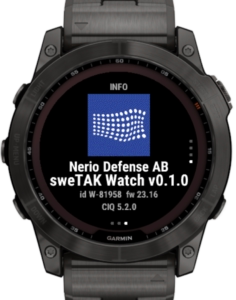
A clear interest in the smartwatch as a companion device
Some of the most useful ideas did not come from the survey scores at all, but from the conversations we had with soldiers during and after the exercise. A theme that came up repeatedly was the wish to stop constantly looking down at the phone for updates. In the field, pulling out a phone to check for new information is both a distraction and a tell-tale sign that can give away position, especially in darkness.
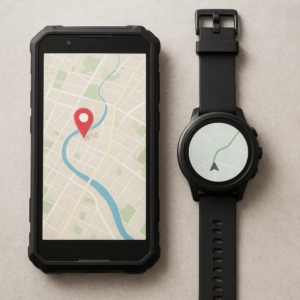
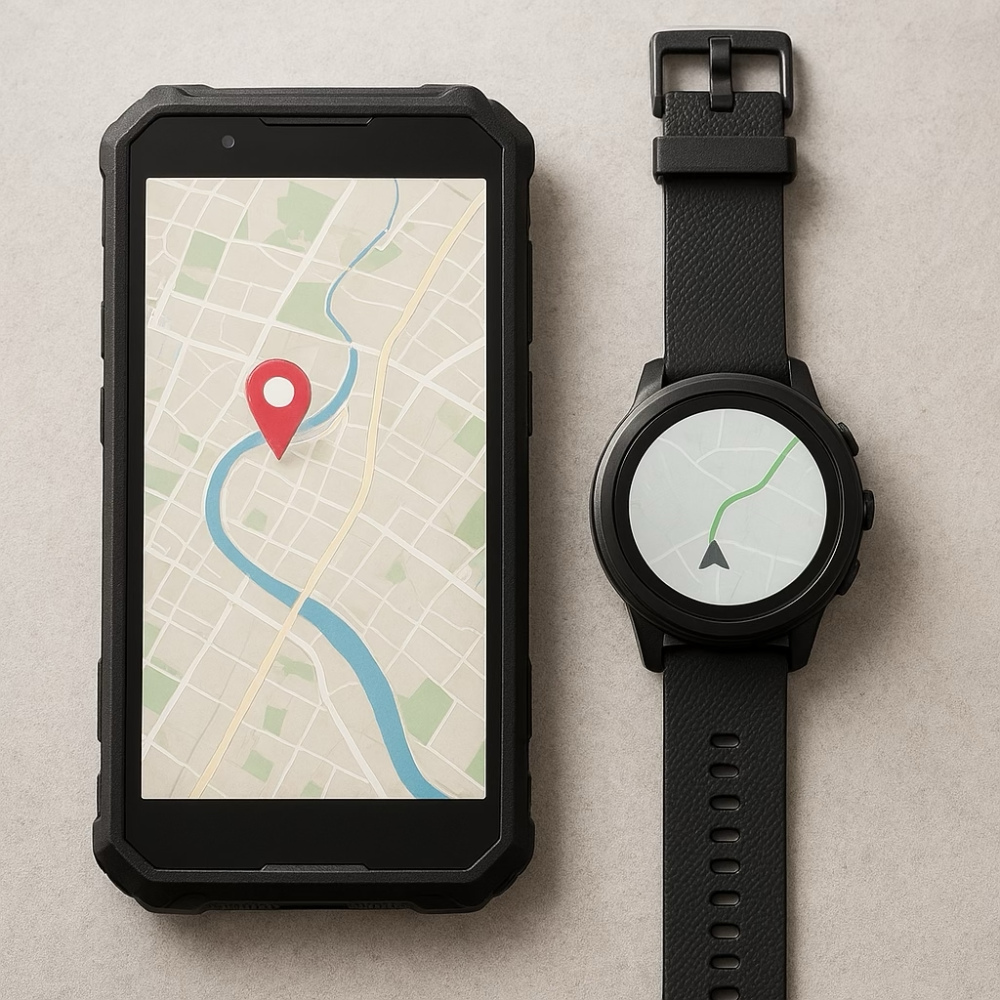
The idea raised was to use a smartwatch as a companion to the phone. Rather than carrying all the detail, the watch would quietly make the soldier aware that there is new information, or that an action is needed, without them having to take out and look at the phone. The phone stays in the pocket; the watch provides a discreet nudge, and the soldier checks the full picture only when it makes sense to.
Beyond alerts, participants also pointed to health monitoring as a natural fit for a wrist-worn device — keeping an eye on the wearer’s condition and flagging when something is wrong. Several related use cases came up in the same discussions, each pointing to functionality we could develop in this direction. Among the ideas raised were:
- Discreet alerts on the wrist for new messages, reports or required actions, so the phone can stay put away.
- Basic health monitoring — for example heart rate and other vital signs — to help keep track of a soldier’s condition.
- Quick acknowledgements or simple status updates sent straight from the watch, without reaching for the phone.
- Lightweight position and movement awareness surfaced on the wrist for fast orientation.
We see real promise here. A smartwatch fits naturally with the idea behind sweTAK — giving each soldier exactly the information they need, when they need it, with as little exposure as possible — and it is an avenue we intend to explore further.
What we are taking away from this
The most useful conclusion is also the most motivating one. The need that sweTAK is built to meet — a shared situational picture and communication in one tool, without the interface clutter — is already understood and wanted by the people doing the job. The challenge is not convincing anyone of the value. It is delivering that value reliably, every time.
So our priorities are straightforward:
- Stability first. Fixing crashes, send-and-receive errors and the Android installation problem comes before any new features.
- Message receipts. A simple “delivered” confirmation was a concrete and repeated request, and we are adding it.
- Explore the smartwatch. The companion-device ideas from the field are a promising direction we will look into.
- More hands-on time at future trials, with a short introduction and a shared routine for recording and filtering information.
- Reporting back. We are sharing these findings with the people who took part, and we will show what we have changed as a result.
A sincere thank you to everyone who took part and answered honestly. Candid feedback from the field is exactly what an early-stage product needs, and it is shaping what comes next for sweTAK.